
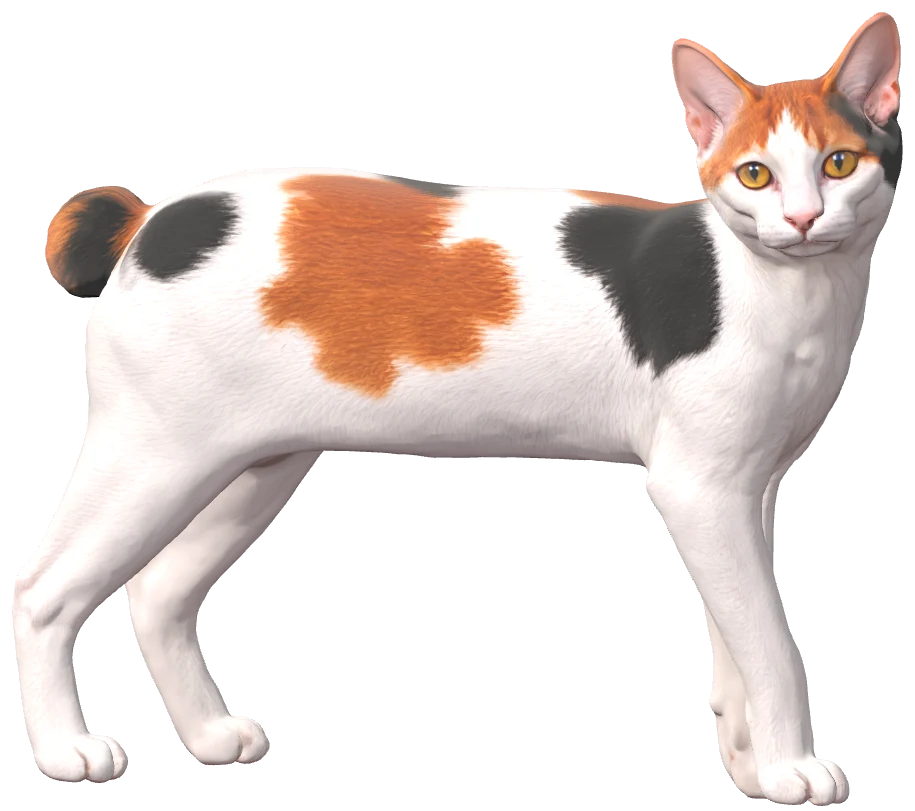
There are two coat lengths.
At a glance
A medium-sized, lean and elegant cat with a short kinked tail, in a short or long silky coat with no noticeable undercoat. Bobtails weigh about 2.7 to 4.5 kg and are a sturdy, natural breed with no specific health concerns. They are active, affectionate and talkative in a soft voice. Sillmates makes the Japanese Bobtail as a desktop pet companion for Mac and Windows, in a Calico coat.
History and origin
Bobtails appear in Japanese scrolls, prints and carvings dating back to the Middle Ages. Accounts of how they first reached Japan differ: the Cat Fanciers' Association says they are thought to have been brought from Korea as far back as the sixth century, while VCA Hospitals says the breed is believed to come from China, and that in the 7th century the Emperor of China gave Bobtails to the Emperor of Japan as gifts. Genetic work points the same way, suggesting the short-tail trait existed in Southeast Asia or China before the cats came to Japan. For centuries they were the pampered darlings of Japanese nobles. Then, in 1602, Japanese authorities decreed that all cats be set free to deal with rodents threatening the silkworms and the silk industry. The Bobtails helped preserve the silkworms and spread throughout the country, until the bobtail became the signature look of most Japanese cats. The first Bobtails were imported to the United States in 1968; shorthairs achieved CFA Championship status in 1976 and longhairs followed in 1993.
Temperament and personality
Often in motion but always interactive and affectionate, the Japanese Bobtail is one of the most entertaining of all feline companions. The CFA describes them as inquisitive, intelligent problem-solvers; VCA Hospitals calls them smart, devoted, affectionate and confident. They love to be involved in everything you do, carrying on a conversation the entire time, and their soft voices produce a variety of sounds without being noisy. They need a fair amount of attention and interaction to thrive, and will ask for it if you do not give enough. Once the pampered darlings of nobles, they are also surprisingly self-sufficient and natural hunters.
Size and build
The Bobtail is medium in size, with males proportionately larger than females. The torso is long, lean and elegant, with well-developed muscle but no coarseness, and the hind legs are noticeably longer than the forelegs. Most weigh roughly 6 to 10 pounds (about 2.7 to 4.5 kg). The tail is the breed's signature: for showing it must be clearly visible and the tail bone must extend no more than three inches from the body. It is made of one or more curves, angles or kinks, its hair fans out into a pom-pom like a bunny tail, and it is unique to each individual cat.
Coat and colours
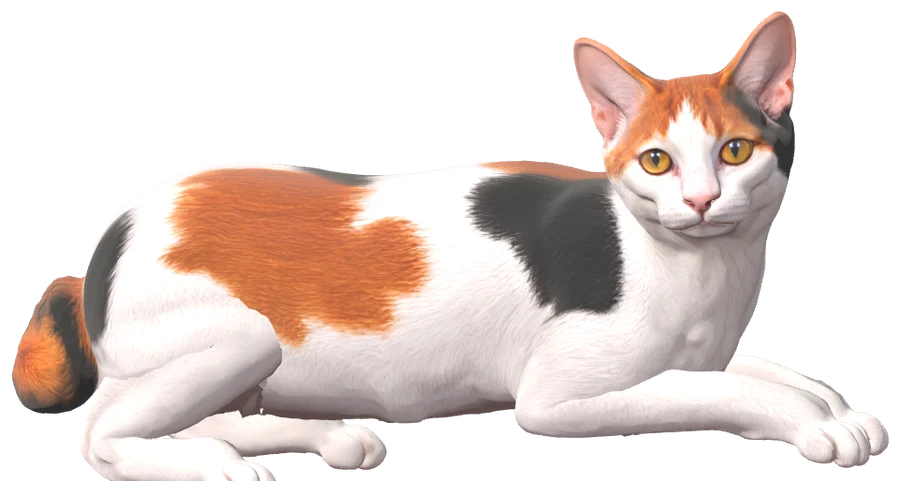
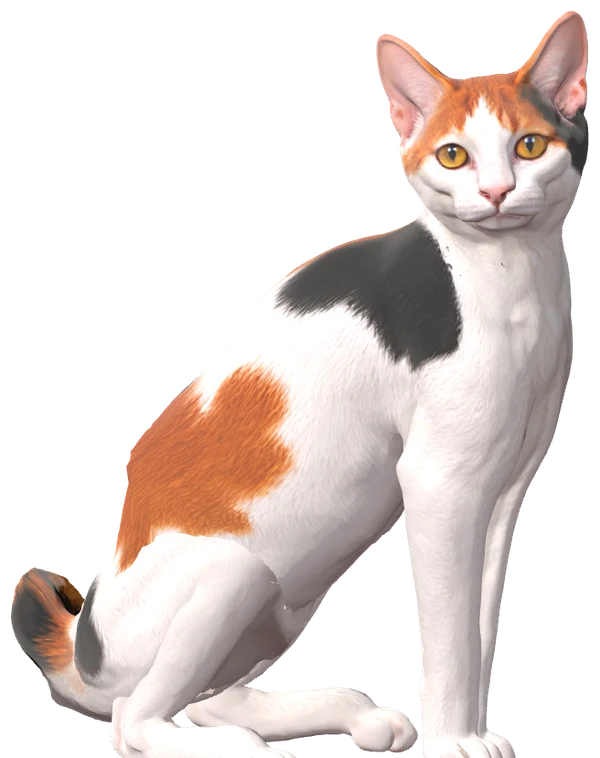
There are two coat lengths. The shorthair coat is medium length, soft and silky, without a noticeable undercoat; the longhair coat is medium-long to long and just as silky, lengthening toward the rump, and longhairs show a frontal ruff, breeches, ear tufts and tufts between the toes. Bobtails come in many colours and patterns, but the most famous is mi-ke (pronounced "mee kay", meaning "three fur"): a calico coat of white with red and black patches, normally seen in female cats. Predominantly white calicos are especially favoured in Japan and in folklore.
Activity and play
Bobtails are natural athletes with a high activity level and a short attention span, and they need to play every day to burn off energy and keep out of trouble. They will happily spend hours playing, they are fond of fetch and feather-wand toys, and they welcome learning commands and tricks. The CFA notes they are playful, agile pets who excel at Feline Agility. Indoors, give them cat towers and shelves to climb and explore, plus regular interactive play sessions with you.
Grooming and care
Grooming is easy. Bobtails have no undercoat and shed only minimally, so shorthairs could hardly be simpler to look after. Longhairs need combing more often with a fine, long-tooth comb, but their coats do not tangle or mat. Brushing every few days removes dead hair and cuts down on hairballs. Bobtails can be prone to begging and overeating, so measure food portions to prevent obesity. It is a good idea to get your cat used to nail trimming and toothbrushing from a young age.
Health and lifespan
The Bobtail is a sturdy, natural breed with no specific health concerns, and recent genetic studies found it one of the most genetically diverse pedigree breeds. Unlike the gene behind the Manx cat's tail, the Bobtail tail gene is not associated with skeletal disorders, and the CFA says there are no known abnormalities linked to the tail. Tails can be rigid or flexible, but all are sensitive and should always be handled with care. Lifespan figures vary between sources: VCA Hospitals gives 15 to 18 years, Wikipedia 9 to 15 years and cats.com 9 to 13 or more. Keep up yearly vet check-ups and see your vet about any change in appetite, weight or behaviour.
Living with one
Bobtails make loving family pets. The CFA says they get along well with dogs and children of all ages, though other cats sometimes need extra time to get used to a cat that seems to have no tail. VCA Hospitals finds them best suited to an active household with other pets. Because they want attention and daily play, they are happiest with people who are home and involved; an indoor home with cat towers, shelves and toys suits them well. Teach children to be gentle with the sensitive tail.
Fun facts
The maneki-neko, the beckoning cat statue with one paw raised found in Japanese shops and restaurants, is a Japanese Bobtail and a traditional symbol of good luck. Every Bobtail's tail is different, so it has been said that each tail is as unique as a fingerprint. Rarely, a mostly white Bobtail has odd eyes, with each eye a different colour.
About the Japanese Bobtail
At a glance.
- Origin
- Japan (ancestors from China or Korea; sources differ)
- Group
- Shorthair and Longhair (CFA)
- Weight
- 2.7–4.5 kg
- Lifespan
- 9-18 (sources disagree: 15-18, 9-15 and 9-13+) years
- Coat
- Short or long, soft and silky, no noticeable undercoat
- Colours
- Mi-ke (calico: white with red and black), Bicolour, Many other colours and patterns
11
Questions about
the Japanese Bobtail.
Why do Japanese Bobtails have short tails?
It is a natural genetic mutation. Each tail is made of curves, angles or kinks, is unique to the cat, and is not associated with the skeletal problems seen with the Manx gene.
Is the beckoning cat a Japanese Bobtail?
Yes. The maneki-neko, a cat statue with one paw raised and a symbol of good luck, is a Japanese Bobtail, most often a calico.
What does mi-ke mean?
Mi-ke ("mee kay") means "three fur", the calico pattern of white with red and black patches, usually seen in female cats.
Are Japanese Bobtails good with children and dogs?
The CFA says they get along well with dogs and children of all ages. Other cats may need extra time to adjust to them.
How long do Japanese Bobtails live?
Sources vary: VCA Hospitals gives 15 to 18 years, while Wikipedia gives 9 to 15 and cats.com 9 to 13 or more. They are a sturdy breed with no specific health concerns.
Do Japanese Bobtails shed much?
No. They have no undercoat and shed only minimally. Longhairs need combing more often, but their coats do not tangle or mat.
12 · Sources
cfa.org/breeds/japanese-bobtailvcahospitals.com/know-your-pet/cat-breeds/japanese-bobtailen.wikipedia.org/wiki/Japanese_Bobtailcats.com/cat-breeds/japanese-bobtail