
Cats · Mac and Windows
Meet the Black Panther.
A black panther is not a species of its own: it is a leopard or a jaguar with a black coat. The colour comes from excess black pigment, and the typical rosettes are still there under it. This page covers the natural history of the wild cat and says plainly why it cannot be a household pet.
Launch price $9.99, was $29.99
Look
Black Panther
01
At a glance
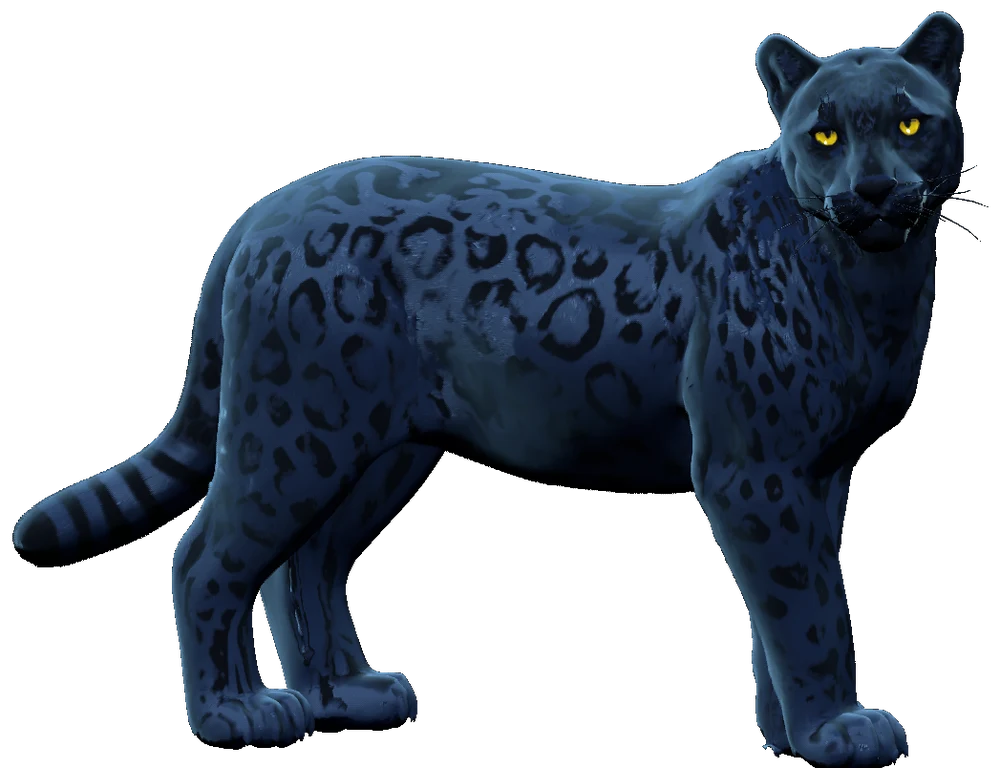
A large, muscular big cat with a black coat. A black panther is a leopard or a jaguar, depending on where it lives, and both are powerful, solitary, mostly night-active hunters. Leopards weigh roughly 21 to 75 kg and jaguars 31 to 121 kg, according to the San Diego Zoo. Sillmates makes the Black Panther as a desktop pet companion for Mac and Windows, in a Black coat.
02
History and origin
The black panther is not a species. Wikipedia describes it as the melanistic colour variant of the leopard (Panthera pardus) and the jaguar (Panthera onca), with black leopards found in Africa and Asia and black jaguars in Central and South America. Black leopards were described in Europe in 1788 from an animal kept in the Tower of London that had been brought from Bengal. Frequency of melanism appears to be approximately 11% over the leopard's range, and it is documented in five wild leopard subspecies. The word panther is a general term that comes from the genus Panthera, and the San Diego Zoo notes it is sometimes used for leopards, jaguars and cougars.
03
Temperament and personality
Wild black panthers behave like the spotted cats of their species. The San Diego Zoo says that except during breeding season, leopards lead a solitary life, and that jaguars are solitary by nature and usually avoid each other. The National Geographic profile says jaguars define their area by marking with their waste or clawing trees. Leopards are stealthy and unpredictable hunters, and they go to great lengths to avoid larger predators such as lions, hyenas and tigers. Leopards live in a wide range of habitats, from high mountains to deserts to rainforests.
04
Size and build
A black panther is as big as the species it belongs to. The leopard is slender and muscular, with a body length of 92 to 183 cm and a shoulder height of 60 to 70 cm; males typically weigh 30.9 to 72 kg and females 20.5 to 43 kg. The jaguar is more heavily built. Wikipedia calls it the biggest cat in the Americas and the third largest in the world, and gives a shoulder height of 57 to 81 cm and typical weights of 56 to 96 kg in most regions. The San Diego Zoo gives a jaguar range of 31 to 121 kg and a length of 1.1 to 1.8 metres, with males larger than females.
05
Coat and colours
The coat is black, but the pattern is still there. Black panthers of both species have excess black pigments, and their typical rosettes are also present, hidden by the excess melanin. In certain light the spots show through, so the cat may look solid black at first glance. Melanism is caused by a recessive allele in the leopard and a dominant allele in the jaguar. It is thought to help in dense forest, where light levels are lower, and black leopards occur foremost in tropical and subtropical moist broadleaf forests. A black cat has no separate coat colours: the only variation is how clearly the rosettes show.
06
Activity and play
Black panthers are mostly active at night. The San Diego Zoo says leopards are usually nocturnal, resting by day and hunting at night, usually in bushes, rocks, caves or up in a tree. Of the large cats, leopards are the most arboreal, with long tails for balance on narrow branches, and they stash food up high so lions or hyenas cannot take it. Jaguars stalk and ambush ground-dwelling prey at night, and they are strong swimmers that typically live near water. The San Diego Zoo says a leopard has no predictable hunting pattern, and that it kills with a bite to the throat.
07
Grooming and care
A black panther is a wild animal, not a household pet, and it needs no grooming or care from an owner. Zoos feed leopards and jaguars a specialist carnivore diet, and nothing about their needs suits a home. Keeping one is restricted by law in many places. In the United States, a 2022 amendment to the Lacey Act requires owners of tigers, lions and other large cats to have a license and prohibits public petting of large cats and their cubs. Leopards and jaguars are the kind of predator that kills prey with a bite to the throat or the skull.
08
Health and lifespan
Lifespan depends on the species and on whether the cat lives in the wild or in a zoo. The San Diego Zoo gives a jaguar lifespan of 12 to 15 years in the wilderness and up to 20 years in zoos, and says the median life expectancy for leopards in human care is about 18 years. Both species are under pressure from people. The leopard is listed as Vulnerable on the IUCN Red List, and the jaguar as Near Threatened. National Geographic notes that jaguars have lost more than half their territory since the 1880s.
09
Living with one
You cannot live with a real black panther. It is a wild predator, and in most places it is illegal or tightly regulated to keep one, as the Lacey Act amendment shows for the United States. The place to see one is a zoo or wildlife park, and the best way to help is to support the conservation of leopards and jaguars in the wild. If you want a black panther on your own screen, a desktop companion is the safe way to have one.
10
Fun facts
Black panthers are not a separate kind of cat, and the rosettes remain under the black coat. A black leopard was photographed in Nepal at 4,300 m on Kanchenjunga, and in Kenya's Laikipia County a black leopard was photographed by a camera trap in 2007. Most leopards recorded south of the Kra Isthmus in Malaysia were black, which indicates near fixation of melanism there. The jaguar is the only big cat in the Americas, and its rosettes often have a dot in the centre, while a leopard's do not.
11
Questions about the Black Panther
Is a black panther its own species?
No. It is the melanistic colour variant of the leopard or the jaguar, caused by excess black pigment.
Can you still see spots on a black panther?
Yes. The typical rosettes are present but hidden by the excess melanin, and they can show in certain light.
How long do black panthers live?
The San Diego Zoo gives jaguars 12 to 15 years in the wild and up to 20 in zoos, and about 18 years for leopards in human care.
Where do black panthers live?
Black leopards live in Africa and Asia, mostly in dense tropical forest, and black jaguars live in Central and South America.
Can you keep a black panther as a pet?
No. It is a wild predator, and keeping large cats is restricted or illegal in many places. In the United States, owners of large cats now need a license.
12